




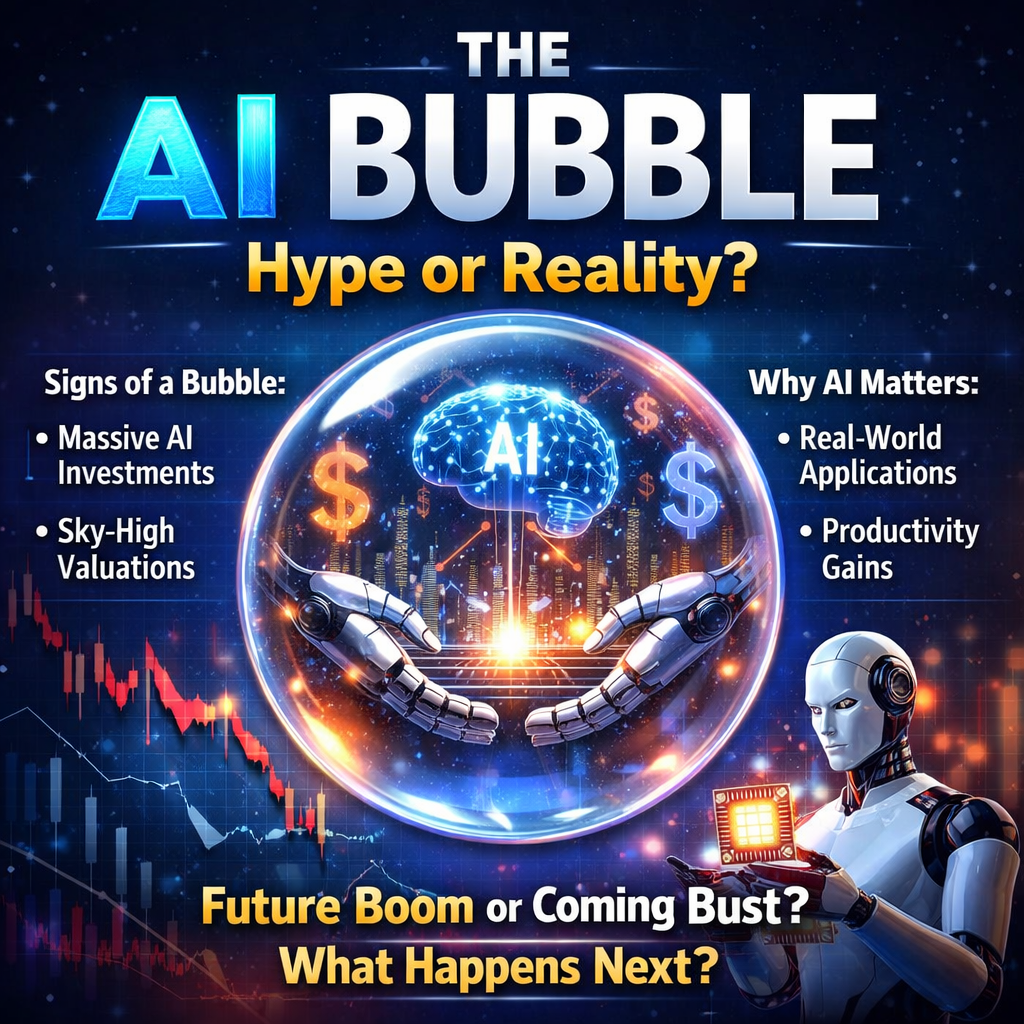
Artificial Intelligence (AI) has rapidly become the centerpiece of the global technology revolution. From chatbots and autonomous systems to predictive analytics and generative models, AI is transforming industries at a pace never seen before. Companies across sectors—from healthcare to finance—are racing to integrate AI into their operations.
But with the explosion of excitement, investment, and expectations around AI, a critical question has emerged:
Are we witnessing the rise of a new “AI bubble”?
This concept has sparked debates among economists, technologists, and investors. To understand whether AI is truly in a bubble, we need to examine what bubbles are, how the current AI boom developed, and what risks and opportunities lie ahead.
Understanding What a “Technology Bubble” Is
A technology bubble occurs when the value of companies or technologies grows rapidly due to hype, speculation, and unrealistic expectations rather than actual business performance or long-term sustainability.
A classic example is the Dot-com Bubble, when investors poured billions into internet companies simply because they had “.com” in their name. Many companies had no profits, no viable business model, and eventually collapsed when the market corrected.
However, the internet itself did not fail—it eventually transformed the global economy.
The same debate is now happening around Artificial Intelligence.
Why People Believe There Is an AI Bubble
Several signs suggest that AI could be experiencing bubble-like behavior.
1. Massive Investment In AI Companies
Global funding for AI startups has skyrocketed. Venture capital firms and large tech companies are investing billions into AI research, infrastructure, and products.
Major technology companies like:
- Microsoft
- Amazon
- NVIDIA
are spending enormous amounts on AI chips, data centers, and software platforms.
For example, Nvidia’s valuation grew dramatically due to demand for GPUs used in AI training and inference.
While this investment reflects genuine technological progress, critics argue that investor expectations may be too high.
2. AI Is Being Added Everywhere
Today, companies often add “AI-powered” features to their products—even when the underlying technology is basic automation or machine learning.
This phenomenon is sometimes called “AI washing.”
Examples include:
- AI-powered marketing tools
- AI productivity assistants
- AI analytics platforms
- AI customer support bots
While some solutions provide real value, others exist primarily to attract investment or marketing attention.
3. Sky-High Valuations
Some AI startups reach valuations of billions of dollars even before becoming profitable.
Companies building large language models or AI infrastructure attract massive funding rounds despite uncertain revenue models.
For example, organizations like:
- OpenAI
- Anthropic
have received multibillion-dollar investments to build advanced generative AI systems.
The risk here is that future profits may not justify today’s valuations.
4. Hardware Spending Is Exploding
Training large AI models requires enormous computing power.
This has led to massive investments in:
- GPUs
- Data centers
- Cloud infrastructure
Companies like NVIDIA dominate the AI chip market, and demand for GPUs has surged worldwide.
But if AI adoption slows or companies cannot monetize AI effectively, this infrastructure investment could become excessive.
Why AI Might NOT Be a Bubble
Despite the concerns, many experts argue that AI is fundamentally different from previous bubbles.
1. AI Is Already Delivering Real Value
Unlike many companies during the Dot-com era, AI technologies are already generating real-world benefits:
- Medical diagnosis support
- Fraud detection in banking
- Supply chain optimization
- Personalized recommendations
- Autonomous systems
Technologies like Machine Learning, Deep Learning, and Generative AI are actively transforming industries.
2. Productivity Gains Are Real
AI tools can automate repetitive tasks, improve decision-making, and enhance productivity across industries.
For example:
- Developers use AI coding assistants
- Analysts use AI for data insights
- Designers generate visuals with AI tools
This productivity boost could lead to significant economic growth.
3. AI Infrastructure Is Becoming Core Technology
Just like electricity and the internet became foundational technologies, AI may become a core infrastructure layer of the digital economy.
Cloud providers like:
- Amazon Web Services
- Google Cloud
- Microsoft Azure
are integrating AI services directly into their platforms, making AI accessible to businesses worldwide.
Signs That an AI Bubble Could Burst
Even if AI is transformational, bubbles can still occur within the ecosystem.
Potential warning signs include:
Overfunded Startups
Too many companies solving the same problem with similar AI tools.
Unsustainable Infrastructure Costs
Training advanced AI models can cost millions of dollars.
Limited Revenue Models
Many AI companies struggle to convert user growth into sustainable profits.
Market Correction
If investors lose confidence, valuations may fall rapidly.
Lessons from the Dot-Com Era
The Dot-com Bubble teaches an important lesson:
Even when bubbles burst, the underlying technology can still reshape the world.
Many companies failed during the dot-com crash, but the internet eventually produced giants like:
- Amazon
Similarly, even if some AI companies fail, the technology itself will likely remain transformative.
The Most Likely Scenario: An AI Market Correction
Rather than a complete collapse, experts believe the AI sector may experience a market correction where:
- Overvalued companies fail
- Sustainable AI businesses survive
- Technology continues evolving
This pattern is common in emerging technologies.
What This Means for Professionals and Businesses
For professionals working in technology—especially cloud and AI—this moment presents both opportunities and challenges.
Opportunities
- High demand for AI skills
- Growth in AI infrastructure and cloud services
- New business models powered by automation
Risks
- Short-term hype cycles
- Unstable startups
- Rapidly changing technologies
Those who focus on fundamentals rather than hype will benefit the most.
Final Thoughts
The AI boom is one of the most significant technological movements of the 21st century. While the industry may experience hype-driven investment cycles, the underlying technology is likely here to stay.
The real question is not whether AI will survive—but which companies, technologies, and professionals will shape its future.
If history repeats itself, some AI companies may disappear when the hype fades. But just like the internet revolution, the long-term impact of Artificial Intelligence could redefine how businesses operate, how people work, and how economies grow.